

Thursday, 15 October 2015


Wednesday, 14 October 2015
Visite ones
Dharmasthala @ Karnataka (D), India

The village is known for its Dharmasthala Temple which houses the shrine of Shiva, Manjunatha, Ammanavaru, Chandranath and the Dharma Daivas (guardian spirits of Dharma) namely Kalarahu, Kalarkayi, Kumaraswamy and Kanyakumari. The temple is unusual in that it is run by a Jain administration and poojas are conducted by Hindu priests of Madhvaorder. Lakshadeepa, the festival of lights, is the annual festival of Dharmasthala in November–December On an average the flow of pilgrims is about 10,000 people a day. A mechanised kitchen provides free food for all pilgrims and there are guest houses with modern amenities.
Dharmastala represents religious tolerance. A Jain Tirthankara is worshipped beside Daivas and Lord Manjunatha (Shiva). The priests are Vaishnavite Brahmins and the guardian of the temple a Heggade (Jain). To those who come here for justice, the Heggade dispenses judgements that are said to represent the will of the deities.
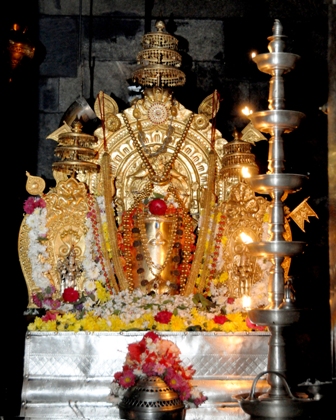
800 years ago, Dharmasthala was known as Kuduma in Mallarmadi, then a village in Belthangady. Here lived the Jain Bunt chieftain Birmanna Pergade and his wife Ammu Ballalthi in a house called Nelliadi Beedu. According to the legend, the guardian angels of Dharma assumed human forms and arrived at Pergade's abode in search of a place where Dharma was being practised and could be continued and propagated. As was their habit, the couple hosted these illustrious visitors with all their wherewithal and great respect. Pleased by their sincerity and generosity, that night the Dharma Daivas appeared in the dreams of Pergade. They explained the purpose of their visit to him and instructed him to vacate his house for the worship of the Daivas and dedicate his life to the propagation of Dharma. Asking no questions, the Pergade built himself another house and began worshiping the Daivas at Nelliadi Beedu.
This worship of daivas continues. The Dharma Daivas again appeared before Pergade to build separate shrines to consecrate the four Daivas — Kalarahu, Kalarkayi, Kumaraswamy and Kanyakumari. Also, Pergade was instructed to choose two persons of noble birth to act as the Daivas' oracles and four worthy persons to assist Pergade in his duties as the executive head of the shrines. In return, the Daivas promised Pergade protection for his family, abundance of charity and renowned for the 'Kshetra'. Pergade, as desired, built the shrines and invited Brahmin priests to perform the rituals. These priests requested Pergade to install a Shivalinga beside the native Daivas. The Daivas then sent their vassal Annappa Swamy to procure thelingam of Shiva from Kadri Manjunath Temple, near Mangalore. Subsequently, the Manjunatha temple was built around the linga.

Bahubali (English: one with strong arms) was the son of Rishabha (first tirthankara and founder of Jainism). Bahubali is a much revered figure among Jains. After winning the nonviolent duel with his elder brother, Bharata, he developed a desire for renunciation. He gave his kingdom to Bharata and became a Jain monk. Bahubali meditated motionless for a whole year in kayotsarga posture because of which climbers grew around his legs. After one year of meditation, he attained Kevala Jnana (omniscience) and became an arihant. A human being who destroys all inner passions like anger, attachment, greed and pride is revered as anarihant. According to Jain texts, he attained moksha at mount Kailasa and became a Siddhai.e., soul at its purest form (or a liberated soul). Bahubali is also called Gommatesh because of the statue dedicated to him. "Gommateshwara" statue, built by the Ganga dynasty minister and commander Chamundaraya, is a 57-foot (17 m) monolith (statue casted from a single piece of rock) and is situated above a hill in Shravanabelagola, in the Hassan district of Karnataka state, India. It was built in around 983 A.D. and is one of the largest free standing statues in the world. On August 5, 2007, the statue was voted by Indians as the first of Seven Wonders of India; 49% of the total votes went in favor of it.
Dudhsagar Water Falls

The magnificent Dudhsagar Waterfall is perched in the high peaks of the Western Ghats and is a sight to behold especially in the monsoons when it is in full and furious flow. From a distance, the waterfall appears like streams of milk rushing down the mountainside. The exhuberent and spectacular waterfall is located in the Sanguem taluka.
Measuring a mighty 600m from head to foot, this waterfall on the Goa-Karnataka border, attracts a steady stream of visitors from the coast into the rugged Western Ghats. After pouring across the Deccan plateau, the headwaters of the Mandovi River form a foaming torrent that splits into three streams to cascade down a near-vertical cliff face into a deep green pool.
The Konkani name for the falls, which literally translated means "sea of milk", derives from clouds of milky foam which rises up at the bottom of the falls. Dudhsagar is set amidst breathtaking scenery overlooking a steep, crescent-shaped head of a valley carpeted with pristine tropical forest, that is only accessible on foot or by train.
Like most places in Goa, the Dudhsagar waterfall too has a legend attached to its name. The legend tells the story of this powerful and wealthy king who ruled a kingdom in the Western Ghats. His lavish and opulent palace in the hills was surrounded by vast gardens which were full of deers and gazelles.
The King had a beautiful daughter, who used to enjoy taking a bath during the hot summers, in the picturesque lake near the forest on the edge of the King's palace grounds. It was her habit to finish her bath and have a jugful of sugared milk in a jug made of pure gold.
One day when she was finishing her usual jug of milk she found herself being watched by a handsome prince standing amongst the trees. Embarassed by her inadequate bathing attire, the resourceful Princess poured the sugared milk in front of her to form an improvised curtain to hide her body, while one of the maids rushed to cover her with a dress.
Thus was the legend born. The sugared milk (dudh) poured down the mountainside and continued to flow in torrents as a tribute to the everlasting virtue and modesty of the Princess of the Ghats. The Dudh Sagar (Sea of Milk) continues to flow to this day and attracts thousands of visitors to one of the most popular and famous tourist spots in the state of Goa.
A number of private operators offer special trips to the Waterfalls and the tours operated by GTDC (Goa Tourism Development Corpn) also have Dudhsagar Waterfalls as one of the tour stops.

The falls can also be reached by a train journey from Vasco or Margao. At Collem, in the Bhagwan Mahaveer Sanctuary near Mollem, there is a railway station where the train stops to pick up passengers for the journey to the waterfalls. There are two trains a day that stop at Dudhsagar Station and it's possible to catch a morning train up and spend several hours at the falls before taking an afternoon train back.
Near the top of the falls, the railway line from Vasco to Londa crosses the mountainside, with excellent views from the train. There also a couple of pools that you can swim in, making Dudhsagar a great place for a day full of fun and frolic. The alternate way of reaching the falls is only advisable between January and May, when the level of the water in the rivers abates enough to permit jeeps to approach the base of the falls.
Tuesday, 13 October 2015

MEDITATION IN DAILY LIFE

How To Practice
Anapanasati Meditation
The Procedure Sit comfortably, Cross the legs,
Joins your hands, Close the mouth,
Close the eyes
Take time to get comfortable
There is nothing else to do, or think about. Just relax!
Be the Breath
Breathe in softly, easily.
Breathe out softly, easily.
Let your breath be calm,
follow your breath.
Be Calm
BE WITH YOUR BREATH
Use your mind
to follow your
breath in ... out ...in ... out,
that is all
Be Still
BE WITH YOUR BREATH
Be with your breath-energy
Anapanasati Meditation is
simple
very easy ..
and not at all difficult
Meditation can be done
by
any one
at any age
at any time
at any place
Meditation should be done
regularly ... every day meditation
should be done ... as per
one’s age in terms of those many
minutes... twenty minutes -
if your age is twenty yars.
Forty minutes - if your age is
forty years and so on.
--------------------------------------------------END----------------------------------------
Monday, 12 October 2015

32,000 Years Old
City Under the Sea-Dwarka?
B.K. Parthasarathy writes about a spectacular underwater archaeological find by a joint British-Indian diving team that could rewrite history.
Who would have thought a city that could be older than the Harappan civilization could be lying beneath water right off the coast of Mahabalipuram?
Sometimes, it pays to listen to the stories of humble fishermen. Local fishermen in the coast of Mahabalipuram in Tamil Nadu have for centuries believed in that a great flood consumed a city over 1,000 years ago in a single day when the gods grew jealous of its beauty.
The myths of Mahabalipuram were written down by British traveler J. Goldingham, who visited the town in 1798, at which time it was known to sailors as the Seven Pagodas. Legend had it that six temples were submerged beneath the waves, with the seventh temple still standing on the seashore.
Best-selling British author and television presenter Graham Hancock took these stories seriously. The hypothesis that there may be ruins underwater off the coast of Mahabalipuram has been around at least since the eighteenth century among scholarly circles.

“I have long regarded Mahabalipuram, because of its flood myths and fishermen’s sightings as a very likely place in which discoveries of underwater structures could be made, and I proposed that a diving expedition should be undertaken there,” said Hancock.
Hancock’s initiative resulted in the Dorset, England-based Scientific Exploration Society and India’s National Institute of Oceanography joining hands. In April this year, the team made a spectacular discovery
The SES announced: “A joint expedition of 25 divers from the Scientific Exploration Society and India’s National Institute of Oceanography led by Monty Halls and accompanied by Graham Hancock, have discovered an extensive area with a series of structures that clearly show man made attributes, at a depth of 5-7 meters offshore of Mahabalipuram in Tamil Nadu.
“The scale of the submerged ruins, covering several square miles and at distances of up to a mile from shore, ranks this as a major marine-archaeological discovery as spectacular as the ruined cities submerged off Alexandria in Egypt.”
India’s NIO said in a statement: “A team of underwater archaeologists from National Institute of Oceanography NIO have successfully `unearthed’ evidence of submerged structures off Mahabalipuram and established first-ever proof of the popular belief that the Shore temple of Mahabalipuram is the remnant of series of total seven of such temples built that have been submerged in succession. The discovery was made during a joint underwater exploration with the Scientific Exploration Society, U.K.”
NIO said:
- Underwater investigations were carried out at 5 locations in the 5 – 8 m water depths, 500 to 700 m off Shore temple.
- Investigations at each location have shown presence of the construction of stone masonry, remains of walls, a big square rock cut remains, scattered square and rectangular stone blocks, big platform leading the steps to it amidst of the geological formations of the rocks that occur locally.
- Most of the structures are badly damaged and scattered in a vast area, having biological growth of barnacles, mussels and other organisms.
- The construction pattern and area, about 100m X 50m, appears to be same at each location. The actual area covered by ruins may extend well beyond the explored locations.
- The possible date of the ruins may be 1500-1200 years BP. Pallava dynasty, ruling the area during the period, has constructed many such rock cut and structural temples in Mahabalipuram and Kanchipuram.
The last claim is questioned by Hancock, who says a scientist has told him it could be 6,000 years old.
Durham University geologist Glenn Milne told him in an e-mail: “I had a chat with some of my colleagues here in the dept. of geological sciences and it is probably reasonable to assume that there has been very little vertical tectonic motion in this region [i.e. the coastal region around Mahabalipuram] during the past five thousand years or so. Therefore, the dominant process driving sea-level change will have been due to the melting of the Late Pleistocene ice sheets. Looking at predictions from a computer model of this process suggests that the area where the structures exist would have been submerged around six thousand years ago. Of course, there is some uncertainty in the model predictions and so there is a flexibility of roughly plus or minus one thousand years is this date.”
If that were true, it would be a spectacular development. Previous archaeological opinion recognizes no culture in India 6,000 years ago capable of building anything much.
Hancock says this discovery proves scientists should be more open-minded. “I have argued for many years that the world’s flood myths deserve to be taken seriously, a view that most Western academics reject. “But here in Mahabalipuram, we have proved the myths right and the academics wrong.”
Hancock believes far more research needs to be done on underwater relics.
“Between 17,000 years ago and 7000 years ago, at the end of the last Ice Age, terrible things happened to the world our ancestors lived in,” he says. “Great ice caps over northern Europe and north America melted down, huge floods ripped across the earth, sea-level rose by more than 100 meters, and about 25 million square kilometers of formerly habitable lands were swallowed up by the waves.
“Marine archaeology has been possible as a scholarly discipline for about 50 years — since the introduction of scuba. In that time, according to Nick Flemming, the doyen of British marine archaeology, only 500 submerged sites have been found worldwide containing the remains of any form of man-made structure or of lithic artifacts. Of these sites only 100 — that’s 100 in the whole world! — are more than 3000 years old.”
Hancock, who was understandably resentful about the NIO’s silence in his pivotal role in making the diving expedition happen — SES gave him full recognition — was himself quite generous about who deserved the greatest credit:
“Of course the real discoverers of this amazing and very extensive submerged site are the local fishermen of Mahabalipuram. My role was simply to take what they had to say seriously and to take the town’s powerful and distinctive flood myths seriously. Since no diving had ever been done to investigate these neglected myths and sightings I decided that a proper expedition had to be mounted. To this end, about a year ago, I brought together my friends at the Scientific Exploration Society in Britain and the National Institute of Oceanography in India and we embarked on the long process that has finally culminated in the discovery of a major and hitherto completely unknown submerged archaeological site.”
– B.K. Parthasarathy is a freelance writer based in Chennai.
--------------------------------------------------END----------------------------------------
--------------------------------------------------END----------------------------------------
Subscribe to:
Posts (Atom)